
After completing the module students will be able to:
• describe different aspects of systems theory and assess where and how systems theory is applicable to real-world problems;
• understand the notion of complexity in the context of systems theory and apply the Systems Thinking concept to model complex systems;
• understand different methods for analyzing system models, including qualitative methods as well as mathematical tools (such as the determination and classification of the systems dynamics);
• apply the learned methods to model and analyse systems on their own and more complex systems with assistance.




In this summer school, participants will learn about immunoinformatics and phylogenetics.
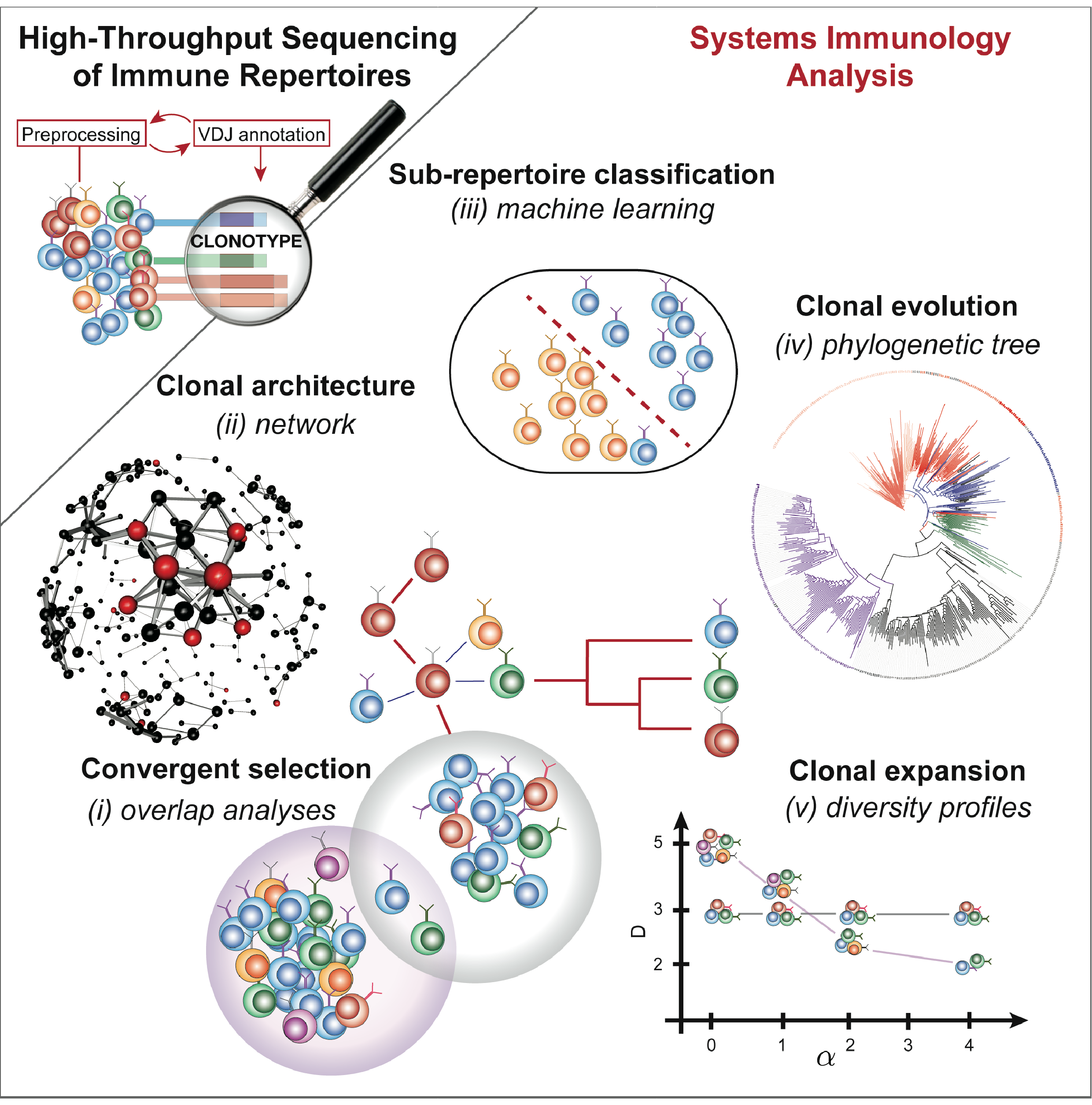
In the immunoinformatics part we will introduce next-generation sequencing (NGS) and antibody repertoires. Part 1 will provide an introduction to the antibody repertoires, consisting of genetic background, generation of diversity, sequencing technologies and a hands-on session on the computational tools available for the analysis antibody repertoire NGS data. Part 2 will focus on the preprocessing and analysis of data. Each step of the preprocessing will be elucidated using the programming platforms of R (or Python), along with existing bioinformatics pipelines available. Repertoire analysis content will provide statistical quantification and visualization of high-dimensional data.
In the phylogenetics part you will be introduced to evolutionary analysis (sequences, alignments, trees, evolutionary models), and work on sequence alignments, and frequentist phylogenetics.
The course will be fully interactive with a project study on HIV and host, the arm-race; participants will be able to download data and example scripts. Please bring your computer.